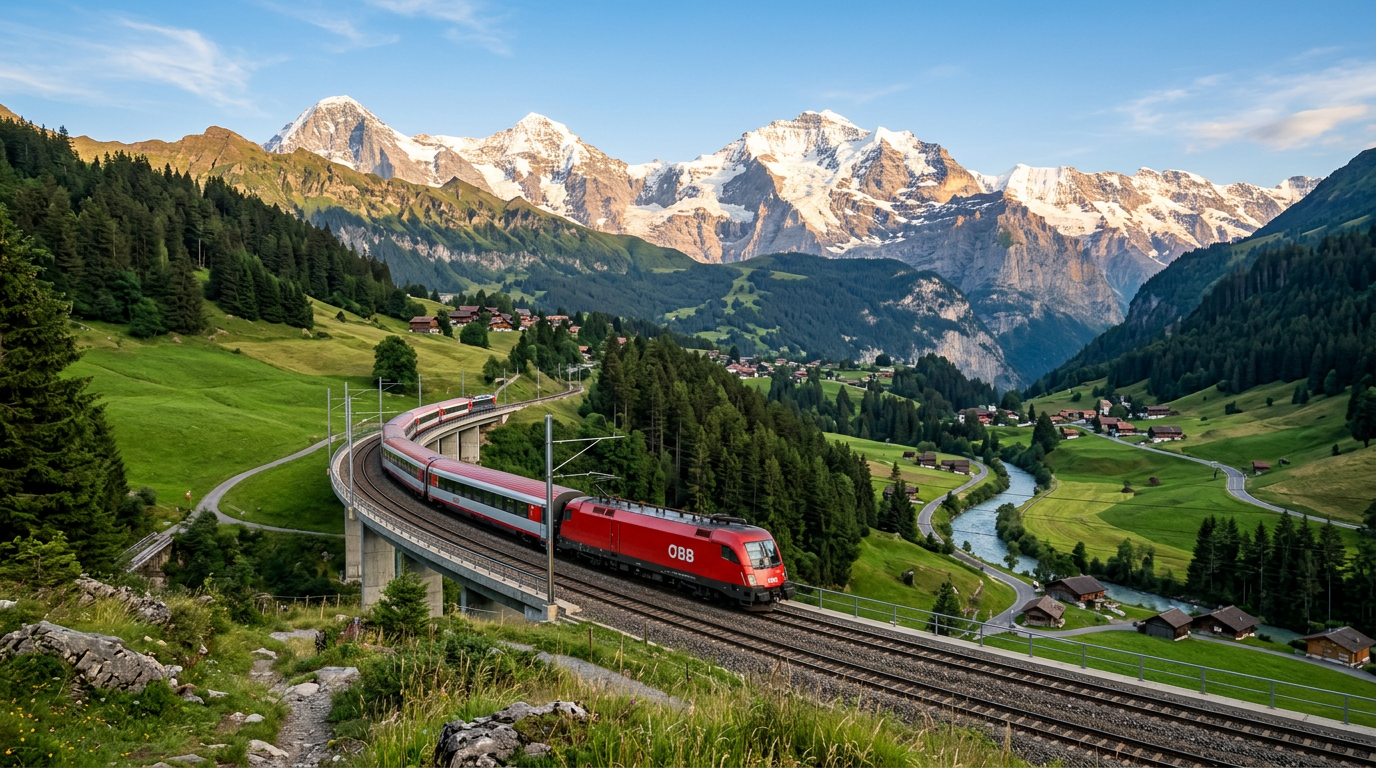
The conversation around sustainable travel has shifted. Five years ago, it was largely aspirational — a handful of eco-lodges and a vague sense that we ought to fly less. In 2026, it's becoming genuinely practical. Rail networks across Europe have expanded, booking platforms now surface carbon data alongside price, and a growing ecosystem of eco-certified accommodation makes lower-impact travel not just possible but straightforward. For UK travellers in particular, the options have never been better.
This guide cuts through the noise. No guilt trips, no greenwashing — just a clear-eyed look at what works, what doesn't, and how to plan a European trip that's kinder to the planet without being miserable for you.
Getting There: Rail Passes and the Eurostar Revolution
The single most impactful decision you'll make is how you cross the Channel. A return flight from London to Paris emits roughly 244 kg of CO₂ per passenger. The same journey by Eurostar produces approximately 11 kg — a reduction of over 95%. And since Eurostar's London–Paris service now runs in 2 hours 16 minutes, the time penalty is negligible once you factor in airport security, baggage claim, and the transfer from Charles de Gaulle to the city centre.
For wider European travel, the Interrail Global Pass remains the cornerstone. The 2026 pricing starts at £278 for four travel days within a month, scaling to £628 for a continuous one-month pass. Key changes this year include the integration of several Spanish AVE routes and improved seat reservation systems through the Rail Planner app. Reservations remain the biggest friction point — France's TGV and Italy's Frecciarossa still require mandatory supplements — but the process has improved markedly since 2024.
"The golden rule for Interrail in 2026: book seat reservations the moment they open, usually 90 days before departure. Popular routes like Paris–Barcelona sell out their Interrail allocation quickly." — The Man in Seat 61
For those who prefer point-to-point tickets, a combination of Eurostar, Thalys (now Eurostar Paris–Brussels–Amsterdam), and Deutsche Bahn's ICE network can get you from London to most major European cities within a day. London to Zurich, for instance, takes roughly 8 hours with a single change in Paris — a long day, but one spent reading, working, or watching the landscape shift from Kent to the Alps.
The Numbers: Comparing Transport Modes
The table below compares the four main transport options from the UK to popular European destinations. Costs are approximate for a single adult booking 4–6 weeks ahead in spring 2026. Carbon figures use UK Government (DEFRA) conversion factors.
| Route | Mode | Approx. Cost | CO₂ (kg) | Journey Time |
|---|---|---|---|---|
| London → Paris | Flight | £45–120 | 122 | 1h 15m + transfers |
| London → Paris | Eurostar | £39–250 | 5.5 | 2h 16m |
| London → Paris | Coach (FlixBus) | £15–40 | 19 | 7h 30m |
| London → Paris | Car (1 occupant) | £80–130 + toll/fuel | 95 | 5h 30m + ferry |
| London → Amsterdam | Flight | £40–110 | 110 | 1h 10m + transfers |
| London → Amsterdam | Eurostar | £40–210 | 7 | 3h 52m |
| London → Barcelona | Flight | £35–150 | 230 | 2h 10m + transfers |
| London → Barcelona | Train (via Paris) | £100–280 | 15 | 10h 30m |
| London → Berlin | Flight | £40–130 | 185 | 1h 50m + transfers |
| London → Berlin | Train (via Brussels) | £120–300 | 12 | 9h 30m |
| London → Berlin | Coach (FlixBus) | £25–60 | 32 | 17h |
A few patterns emerge. For short-haul routes (Paris, Brussels, Amsterdam), the train is competitive on time, often cheaper when booked early, and dramatically cleaner. For medium-haul (Barcelona, Berlin, Zurich), the train takes significantly longer but remains practical for travellers willing to treat the journey as part of the holiday. For anything beyond roughly 1,000 miles, the time cost of overland travel becomes substantial — at which point a direct flight with a credible offset may be the pragmatic choice.
Eco-Certified Accommodation: What the Labels Mean
The accommodation sector is awash in green claims, which makes trusted certification schemes essential. Here are the labels worth paying attention to:
- EU Ecolabel: The most rigorous pan-European standard. Properties must meet strict criteria across energy, water, waste, and chemical use. Currently covers over 900 accommodations in Europe.
- Green Key: Operated by the Foundation for Environmental Education. Present in 65 countries with over 3,200 certified properties. Criteria are robust, with annual audits.
- GSTC-Recognised: The Global Sustainable Tourism Council doesn't certify directly but recognises other certification bodies. If a scheme is GSTC-recognised, its standards have been independently verified.
- B Corp Certified: Not tourism-specific, but a growing number of hotel groups (including several boutique chains) hold B Corp status, which covers social and environmental performance across the entire business.
Booking platforms are catching up. Booking.com's "Travel Sustainable" badge — while imperfect — now covers over 100,000 properties and provides a starting point for comparison. More useful is the new integration with Green Key and EU Ecolabel data, which lets you filter for genuinely certified options rather than self-declared ones.
Carbon Offsetting: The Honest Assessment
Carbon offsetting is the most contentious topic in sustainable travel, and for good reason. The principle is simple: pay someone to reduce or remove the equivalent CO₂ your journey produces. The execution is deeply complicated.
"Offsetting should be the last resort, not the first step. Reduce what you can, then offset the unavoidable remainder through the highest-quality schemes you can find." — Dr Alice Sheringham, Imperial College London
The problems with many offset programmes are well documented: double counting, non-additionality (the trees would have been planted anyway), permanence risk (forests burn down), and questionable verification. Studies published in 2025 found that the majority of forestry-based credits on the voluntary market did not deliver the claimed reductions.
That said, not all offsets are equal. If you choose to offset, prioritise:
- Removal over avoidance: Projects that actively remove carbon (biochar, direct air capture, enhanced rock weathering) are more reliable than those that claim to prevent future emissions.
- Gold Standard or Verra VCS with additional verification: These registries have tightened their methodologies significantly. Gold Standard projects, in particular, require co-benefits for local communities.
- Transparency: Any credible provider publishes project-level detail, third-party verification reports, and explains their pricing. If the offset costs less than £15 per tonne of CO₂, be sceptical.
On the Ground: Travelling Lighter Once You Arrive
Sustainable travel doesn't end at the border. How you move around, eat, and spend once you arrive matters just as much as how you got there. A few principles that make a tangible difference:
- Use local public transport. Most European cities have excellent metro, tram, and bus networks. A week's transport pass in Berlin costs €36; in Lisbon, €40. Both are cheaper and more efficient than ride-hailing.
- Stay longer in fewer places. The sustainable travel mantra is "slow down." Two weeks in one region beats a seven-city, seven-night sprint. You use less transport, eat at local restaurants instead of chains, and actually learn something about where you are.
- Eat seasonally and locally. This isn't about being virtuous — it's about eating better food. A market lunch in Provence or a bacalhau in Lisbon's Alfama will cost less and taste better than any tourist-trap restaurant near the main square.
- Carry a refillable bottle. Tap water is safe to drink in the vast majority of Western and Central Europe. The exceptions (parts of rural southern and eastern Europe) are well documented. A reusable bottle eliminates dozens of plastic purchases per trip.
- Choose experiences over things. Guided walks, cooking classes, live music, and museum visits have negligible environmental footprints. Souvenirs manufactured overseas and shipped to tourist shops do not.
The Overnight Train Renaissance
Perhaps the most exciting development in European rail is the return of the night train. ÖBB's Nightjet network now connects Vienna to Paris, Brussels, Amsterdam, Berlin, Hamburg, Rome, and Venice. Swedish operator Snälltåget runs summer services from Stockholm to Berlin. European Sleeper launched its Brussels–Berlin route in 2024, and the Paris–Berlin Nightjet has proven so popular that additional frequencies were added for 2026.
For UK travellers, the itinerary is elegant: take an afternoon Eurostar to Brussels or Paris, board a Nightjet, and wake up in Vienna, Munich, or Milan. The cost of a couchette (six-berth compartment) starts at around €50; a private sleeper cabin from €130. You save on a night's accommodation, skip airport security, and arrive in the city centre rather than 30 km out at an airport.
"I took the Nightjet from Paris to Vienna last autumn. Fell asleep somewhere in Bavaria, woke up sliding through the Danube valley at dawn. No flight will ever give you that." — Reader submission, SoundsInspired travel letters
Building a Sustainable Trip: A Step-by-Step Framework
To pull this all together, here's a practical framework for planning a lower-impact European trip from the UK:
- Choose your destination based on accessibility. Can you reach it by train in a day or overnight? Paris, Amsterdam, Brussels, Cologne, Lyon, Bordeaux, Barcelona, Zurich, Milan, and Vienna are all within reach without flying.
- Book rail early. Eurostar and European rail operators release tickets 90–180 days ahead. Early booking can reduce the cost of a London–Barcelona train journey from £280 to £80.
- Select certified accommodation. Filter for EU Ecolabel or Green Key on your booking platform. If using Airbnb, look for hosts who mention specific sustainability practices (solar power, composting, local sourcing) rather than vague "eco-friendly" claims.
- Plan a slower itinerary. Resist the urge to pack in five cities. Two or three bases with day trips lets you travel lighter and experience more depth.
- Offset the unavoidable remainder. If you've flown, or driven, calculate the emissions and offset through Gold Standard or a verified removal programme. Budget £20–40 per tonne of CO₂ for credible offsets.
- Track and improve. Apps like Pawprint and North allow you to log your travel emissions over time. Seeing the numbers helps you make better decisions on the next trip.
What About the Cost?
The persistent myth is that sustainable travel costs more. In some cases, it does — a Nightjet sleeper cabin is pricier than a Ryanair flight booked six months early. But the full picture is more nuanced. Train travel eliminates airport transfer costs, luggage fees, and the premium for city-centre hotels near stations rather than airport-adjacent accommodation. Eating at local markets instead of tourist restaurants saves money. Staying longer in one place means fewer transfers and check-in/check-out days.
When a group of researchers at the University of Leeds tracked the total trip cost (not just the headline transport fare) for 200 UK travellers in 2025, they found that those who took the train to Europe spent, on average, 8% more on transport but 12% less on the trip overall — because their itineraries were slower, more local, and less consumptive.
The Bigger Picture
Aviation accounts for roughly 2.5% of global CO₂ emissions, and around 3.5% when non-CO₂ effects like contrails and nitrogen oxides are included. Tourism, more broadly, contributes an estimated 8% of global greenhouse gas emissions. Individual choices matter — not because one person skipping a flight to Malaga will save the climate, but because aggregate demand shapes infrastructure investment, airline capacity decisions, and government transport policy.
The more people take the Eurostar, the stronger the business case for expanded services. The more travellers book eco-certified accommodation, the faster the rest of the industry follows. Sustainable travel in 2026 is not about perfection. It's about making the better choice when the better choice is available — and increasingly, it is.