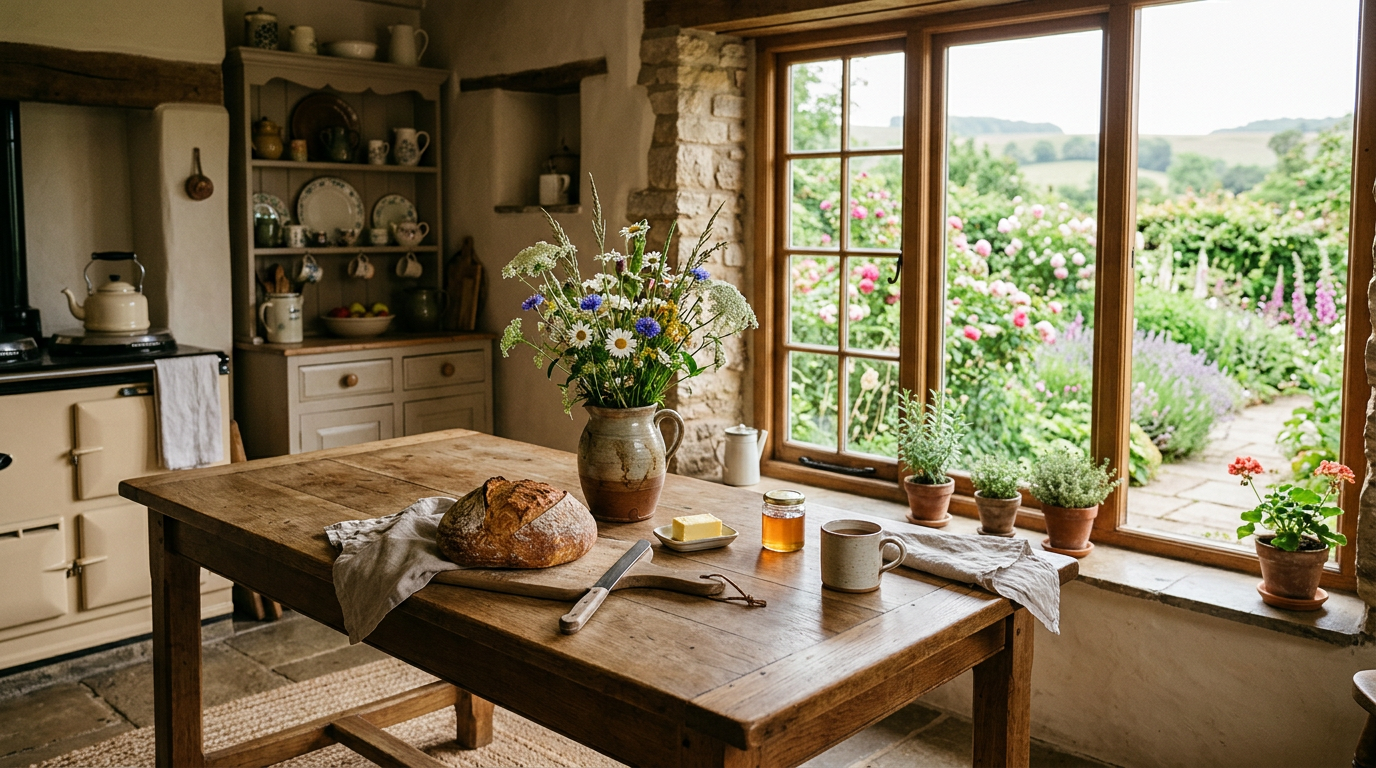
Something curious is happening in Britain. In a country that invented the Industrial Revolution and spent centuries celebrating productivity as a moral virtue, a growing number of people are deliberately choosing to do less. They are leaving London for market towns in Somerset. They are turning down promotions to protect their weekends. They are growing vegetables on allotments, baking sourdough without posting it on Instagram, and measuring their wealth not in salary but in unscheduled hours. The slow living movement — once dismissed as a middle-class fantasy — has become a genuine cultural shift, driven by burnout, a post-pandemic reassessment of priorities, and mounting evidence that the relentless pursuit of more is making us measurably less happy.
What Slow Living Actually Means
Slow living is not about doing everything at a snail's pace, nor is it about rejecting modernity entirely. At its core, it is about intentionality — making deliberate choices about how you spend your time, money, and energy rather than defaulting to the pace dictated by work culture, social media, or consumer expectations. The movement draws from several intellectual traditions: the Italian Slow Food movement founded by Carlo Petrini in 1986, Scandinavian concepts like lagom (just the right amount) and hygge (cosy contentment), Japanese wabi-sabi (finding beauty in imperfection), and the broader minimalism philosophy popularised in the 2010s.
In practice, slow living looks different for everyone. For some, it means downsizing from a four-bedroom house to a two-bedroom cottage and eliminating a mortgage. For others, it means switching from a high-pressure career to freelance work that allows school pickups. For many, it simply means cooking from scratch three nights a week instead of ordering Deliveroo, reading a book instead of scrolling TikTok, or walking to the shops instead of driving. The common thread is a conscious decision to trade speed and convenience for presence and quality.
The Four-Day Work Week: Britain Leads the Way
Perhaps the most visible expression of slow living in the UK is the accelerating adoption of the four-day work week. The landmark 2022 pilot programme, coordinated by the 4 Day Week Global campaign and researchers at the University of Cambridge, involved 61 UK companies and roughly 2,900 employees. The results, published in early 2023, were striking: revenue remained stable or increased at 95% of participating firms, employee wellbeing scores rose by an average of 39%, and 92% of companies chose to continue the four-day model permanently after the trial concluded.
By early 2026, the movement has expanded dramatically. Over 400 UK businesses have formally adopted a four-day week, spanning sectors from technology and marketing to manufacturing and healthcare. The Autonomy think tank estimates that approximately 1.2 million British workers now operate on a four-day schedule, a fivefold increase since 2023. Parliamentary interest is growing too — a Private Member's Bill proposing a statutory right to request a four-day week reached its second reading in late 2025, and while it did not pass, it attracted cross-party support and is expected to return in a revised form.
"We were terrified it would hurt the business. Instead, our team became sharper, more focused, and significantly less likely to call in sick. Absenteeism dropped by 65% in the first year. We will never go back to five days."
The Great Rebalancing: Why Now?
The timing of slow living's ascent in Britain is not accidental. The COVID-19 pandemic forced millions of people to experience, for the first time, a life without commuting, office politics, and the relentless performative busyness that characterised pre-pandemic work culture. Many discovered that they preferred it. A 2025 survey by the Resolution Foundation found that 43% of UK workers who experienced remote working during the pandemic made at least one significant lifestyle change as a result — moving to a cheaper area, reducing working hours, changing careers, or starting a side project aligned with personal values rather than earning potential.
The cost-of-living crisis has paradoxically reinforced the trend. As housing costs, energy bills, and food prices climbed sharply between 2022 and 2025, many Britons were forced into frugality — and discovered that a simpler life was not the deprivation they had feared. Cooking at home, repairing rather than replacing, buying secondhand, and cancelling unused subscriptions saved money but also created a sense of competence and self-sufficiency that conspicuous consumption never provided. The Office for National Statistics reported that UK household savings rates reached 12.1% in late 2025, the highest level since the early 1990s, suggesting that reduced spending is becoming structural rather than temporary.
Minimalism Goes Mainstream
The decluttering movement that Marie Kondo popularised in the mid-2010s has evolved into something deeper and more philosophical in Britain. It is no longer just about tidying your wardrobe — it is about questioning the entire acquisition cycle. Charity shops are experiencing a renaissance: the Charity Retail Association reported a 22% increase in donations and a 17% increase in sales across UK charity shops in 2025, with the strongest growth in clothing, books, and homewares. Vinted, the secondhand fashion platform, now has over 10 million active UK users, making Britain its largest market globally.
The shift is generational but not exclusively so. While millennials and Gen Z are most likely to identify with minimalism, a growing number of older Britons are downsizing proactively — selling the family home before retirement, clearing decades of accumulated possessions, and investing the proceeds in experiences rather than things. Estate agents in desirable rural areas report that "right-sizing" moves by over-55s now account for nearly a third of all transactions in towns like Frome, Totnes, and Hebden Bridge.
Slow Living Approaches Compared
Slow living is not a single prescription. Different approaches suit different circumstances, budgets, and temperaments. The table below compares the most common pathways British practitioners are taking, with honest assessments of cost, time commitment, and likely impact.
| Approach | Upfront Cost | Weekly Time | Savings Potential | Wellbeing Impact | Difficulty |
|---|---|---|---|---|---|
| Digital minimalism | None | Saves 5–10 hrs | £20–50/mo (fewer impulse buys) | High — better sleep, focus, and mood | Moderate |
| Meal planning & slow cooking | £20–50 (equipment) | 3–5 hrs | £150–300/mo vs takeaways | Moderate — better nutrition, family time | Easy |
| Four-day work week | None (if employer offers) | Saves 8–10 hrs | Variable (often 20% pay cut) | Very high — reduced burnout, more autonomy | Hard (requires employer buy-in) |
| Downsizing / relocation | £2,000–10,000 (moving costs) | Saves commute time | £500–1,500/mo (lower housing costs) | Very high — less financial stress, more space | Very hard (major life change) |
| Grow-your-own / allotment | £50–200 (tools, seeds) | 3–6 hrs | £30–80/mo (seasonal produce) | High — outdoor activity, sense of purpose | Easy to moderate |
| Capsule wardrobe / secondhand only | None | Saves 1–2 hrs | £100–250/mo (reduced clothing spend) | Moderate — less decision fatigue | Easy |
| Sabbatical / career break | 3–12 months' expenses saved | Full reclamation | Negative (no income) | Transformative — but requires planning | Very hard (financial barrier) |
The most effective entry points for most people are digital minimalism and meal planning — they cost almost nothing, deliver rapid results, and build the confidence and headspace needed to consider larger changes. Downsizing and career breaks deliver the most dramatic transformations but require significant financial preparation and should not be undertaken impulsively.
The Economics of Enough
Critics of slow living argue that it is a privilege available only to those who already have enough. There is some truth in this — it is easier to romanticise simplicity when your basic needs are comfortably met. But the data tells a more nuanced story. Research from the University of Leeds published in 2025 found that the strongest predictors of life satisfaction in the UK were not income level but rather sense of autonomy, quality of close relationships, and time spent in nature — all of which are enhanced by slow living practices and none of which require wealth. Participants earning below the median income who adopted even two slow living practices reported life satisfaction scores comparable to those earning twice as much who had not.
The financial maths can be surprisingly favourable. A couple earning a combined £55,000 who relocates from outer London to a market town in the Midlands can realistically reduce their annual housing costs by £8,000 to £12,000, their commuting costs by £3,000 to £5,000, and their childcare costs by £2,000 to £4,000 — a total saving of £13,000 to £21,000 per year. Even accounting for lower salaries outside London, the net financial position often improves, while gaining a larger home, shorter commute, and access to countryside. The real barrier is not money but inertia, social expectations, and the very human fear of making a change you cannot easily reverse.
Slow Living and Mental Health
The mental health case for slow living is increasingly well evidenced. A 2025 meta-analysis published in The British Journal of Psychiatry examined 34 studies on lifestyle simplification and psychological wellbeing, finding consistent reductions in anxiety symptoms (average 31% improvement), depressive symptoms (24% improvement), and perceived stress (29% improvement) among participants who adopted intentional simplification practices for three months or more. The mechanisms are multiple: reduced financial pressure, more restorative sleep, increased physical activity, stronger social bonds, and a greater sense of personal agency.
"We medicalise stress and prescribe medication, when often the most effective intervention is structural: work less, spend less, do fewer things, and do them properly. Slow living is not alternative medicine — it is common sense dressed in a trendy name."
A Practical Getting-Started Guide
If the idea of slow living appeals to you but the prospect of overhauling your entire life feels overwhelming, start with what the psychologist BJ Fogg calls "tiny habits" — changes so small they require almost no motivation. The following four-week plan requires no expenditure, no major decisions, and no disruption to your existing commitments.
- Week 1 — Audit your time: Track how you spend every hour for seven days using a simple notebook. Most people are shocked to discover how much time disappears into low-value screen use, unnecessary errands, and activities driven by obligation rather than choice. Do not change anything yet — just observe.
- Week 2 — Subtract one thing: Based on your audit, identify the single lowest-value activity in your week and eliminate it. This might be a subscription you never use, a social commitment you dread, or a daily habit (like the morning news scroll) that adds more stress than information. Replace it with nothing — leave the space empty and see how it feels.
- Week 3 — Add one ritual: Introduce one slow, intentional activity that you genuinely enjoy. A twenty-minute walk without your phone. A home-cooked meal eaten at the table without screens. A Sunday morning spent reading in bed. The key is regularity — do it at the same time, in the same way, until it becomes automatic.
- Week 4 — Reflect and commit: At the end of the month, honestly assess what has changed. Are you sleeping better? Do you feel less rushed? Are your relationships benefiting from your increased presence? If the answer is yes to even one of these questions, you have the evidence you need to continue. Choose one more thing to subtract and one more to add, and repeat the cycle.
The Slow Future
The slow living movement is not a rejection of progress. It is a correction — an acknowledgement that the metrics by which we have measured success for decades (income, output, acquisitions, followers) do not correlate well with the things that actually make life worth living: health, relationships, purpose, and peace of mind. Britain, with its strong tradition of civic life, its extraordinary countryside, and its growing willingness to challenge outdated working patterns, is unusually well placed to lead this cultural recalibration.
The numbers suggest this is not a passing trend. The four-day week is expanding. Charity shop culture is thriving. Rural relocation is accelerating. Screen time awareness is growing. These are not isolated phenomena — they are expressions of a single, coherent shift in values. The Britons who are choosing less are not opting out. They are opting in — to a life that is smaller in scale but larger in meaning. And the rest of us, still sprinting on the treadmill, are starting to wonder whether they might be right.