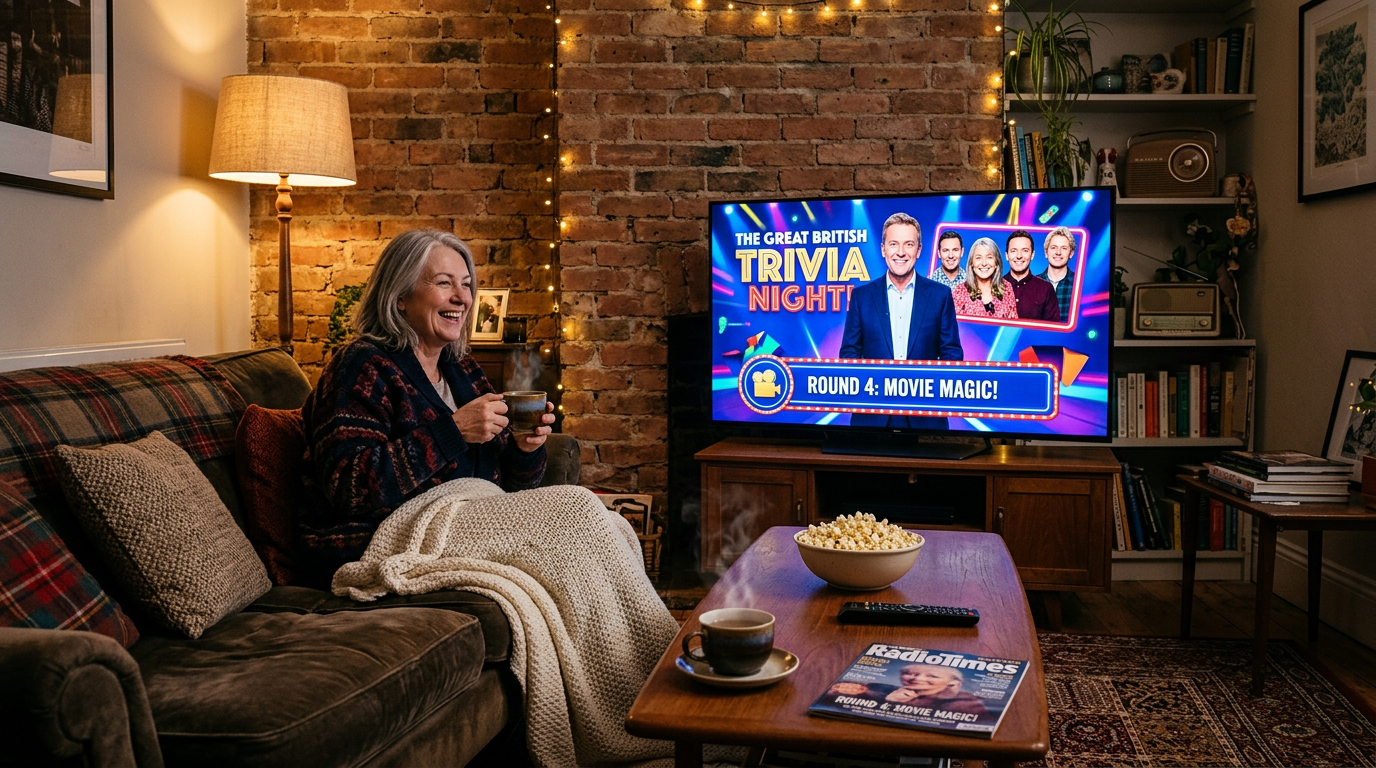
There is a particular kind of television moment that transcends the programme it belongs to. It enters the collective vocabulary, becomes a shorthand, gets quoted at dinner tables and in office kitchens by people who may never have watched the original episode. These are the scenes that shifted something — that proved a format could work, that redefined what was acceptable to broadcast, or that simply lodged themselves so firmly in public memory that they became part of the culture itself. What follows is not a ranking but a chronology: fifteen moments that altered the trajectory of British television viewing, from the golden age of sitcoms to the streaming era.
1. Fawlty Towers — The Germans Arrive (1975)
John Cleese has always maintained that "The Germans" was a fairly straightforward farce episode, built on the single premise that a man who cannot stop himself from saying the wrong thing is placed in a situation where saying the wrong thing has genuine social consequences. The result was something far greater than its premise. Basil's spiralling attempts at diplomatic conversation, each one veering closer to catastrophe, culminated in the infamous goose-stepping sequence — a piece of physical comedy so precisely timed that even Cleese himself has admitted he is unsure how much was scripted and how much emerged in the heat of performance. It has been voted the greatest moment in British comedy more times than anyone has bothered to count.
2. Blackadder Goes Forth — The Final Whistle (1989)
For three and a half series, Blackadder was a comedy — sharp, cynical, increasingly brilliant, but fundamentally a comedy. Then Richard Curtis and Ben Elton chose to end their fourth series not with a joke but with silence. The final scene of "Goodbyeee," in which Blackadder, Baldrick, George, and Darling go over the top into no man's land, dissolving into slow motion and then into a field of poppies, remains one of the most discussed endings in the history of British television. It worked precisely because it refused to be funny. Audiences expecting a punchline received something that hit considerably harder, and the contrast between the comedy that preceded it and the gravity of those final ninety seconds taught an entire generation that television could do both things simultaneously.
3. Only Fools and Horses — The Batman and Robin Entrance (1996)
The annual Only Fools and Horses Christmas specials were, throughout the 1990s, closer to national events than television episodes. The 1996 instalment, "Heroes and Villains," contained a single sight gag that became arguably the most replayed moment in BBC comedy history: Del Boy and Rodney, running late for a fancy dress party, sprinting through a fog-covered Peckham estate dressed as Batman and Robin. The joke requires no context, no knowledge of the characters, no setup — it works entirely on the absurdity of the image. An estimated 21.3 million viewers watched it on first broadcast, and the clip has been reshared so frequently online that it has become a visual shorthand for British comedy itself.
4. The Office (UK) — David Brent Hits the Dance Floor (2001)
Ricky Gervais had spent an entire series building David Brent as a man whose self-awareness operated on a permanent five-second delay. The dance scene in series two was where that delay collapsed entirely. Performed to a baffled training seminar audience, the dance was — by Gervais's own account — largely improvised, and the visible discomfort of the cast and crew in the background footage was authentic. What made it revolutionary was not the comedy but the discomfort: the scene asked audiences to laugh and wince simultaneously, establishing a template for cringe comedy that British television has been following ever since. It remains the single most cited moment in any discussion of post-millennium British sitcoms.
5. The IT Crowd — "Have You Tried Turning It Off and On Again?" (2006)
Graham Linehan built an entire sitcom around a single help-desk exchange, and the remarkable thing is that it worked for four series. Roy and Moss's weary, rehearsed response to every IT support call became not just a running gag but a genuine piece of workplace vernacular — something that actual IT professionals adopted, half-ironically, as their own catchphrase. The scene in which the question is answered with increasing exasperation, ending with the caller's sheepish admission that they had not, in fact, attempted this most basic of remedies, distilled a very specific kind of professional frustration into twenty-three minutes of perfect television.
6. Peep Show — The Turkey Dinner (2007)
Peep Show's first-person camera conceit meant that discomfort was never abstract — it was experienced from directly inside the characters' heads. The series four dinner party episode pushed this format to its structural limit. What begins as a mildly awkward social engagement escalates, through a chain of decisions each individually justifiable and collectively insane, into a scenario involving an accidentally killed dog, an improvised concealment, and a meal served to unsuspecting guests. The audience's laughter during this sequence has a distinctly horrified quality. It demonstrated that the show's format could sustain genuine narrative tension alongside comedy, and it remains the episode most commonly recommended to people who have never watched the series.
7. Gavin and Stacey — The Christmas Proposal (2019)
When James Corden and Ruth Jones announced a one-off Gavin and Stacey Christmas special after a decade-long hiatus, expectations were cautious. When 18.5 million people tuned in on Christmas Day — making it the most-watched scripted programme of the decade — those expectations were comprehensively exceeded. The final scene, in which Nessa proposes to Smithy on Barry Island, cut to black before his answer, leaving the nation suspended mid-cliffhanger over the Christmas pudding. It was a masterclass in understanding the audience: the writers knew that the unanswered question would generate more conversation than any resolution could.
"The best television comedy doesn't just make you laugh. It gives you something to argue about the next morning." — Mark Gatiss
8. Fleabag — The Priest Sees the Camera (2019)
Phoebe Waller-Bridge had spent one and a half series training audiences to accept Fleabag's direct-to-camera addresses as a private channel — an intimate aside that existed outside the reality of the show. Then Andrew Scott's Priest glanced at the camera, and the entire architecture of the series shifted. It was a moment that rewrote the rules the show had established, and it carried emotional weight because the fourth wall had been so carefully maintained until that point. Critics described it as the most significant formal innovation in British television comedy since the mockumentary format. The final scene, in which Fleabag walks away from the camera and, by implication, from the audience, closed the loop with devastating precision.
9. The Graham Norton Show — The Red Chair (2007–present)
The format is disarmingly simple: a member of the public sits in a red chair, tells a story, and if the story fails to hold attention, Graham Norton pulls a lever and tips the chair backwards. What makes it work is not the mechanism but the reactions — the celebrity guests' visible struggle to decide whether a story merits saving, the teller's rising panic, the moment of communal judgment. It is, in essence, live storytelling with consequences, and the clips from these segments have been viewed billions of times across social media platforms. The red chair proved that the most compelling television format is often the simplest one.
10. Succession — Tom's Birthday Rap (2018)
Matthew Macfadyen's Tom Wambsgans was, from the beginning, Succession's most unpredictable comic element — a man performing confidence with such transparent desperation that every scene he occupied became unstable. The birthday rap for Siobhan, delivered with karaoke conviction in front of a family professionally trained to suppress emotion, was the moment Tom's specific genius became undeniable. Macfadyen reportedly performed multiple takes; the production team selected the one in which his sincerity was most visibly, painfully intact. The scene has been cited by comedy writers as proof that prestige drama and genuine comedic set-pieces can occupy the same frame without either suffering.
11. Friends — The "We Were on a Break" Aftermath (1997)
The phrase entered the language so completely that most people who use it have no idea which episode it originated in. Ross's defence, delivered with increasing volume and decreasing persuasiveness across multiple series, became the most durable running joke in American sitcom history — not because it was the funniest, but because it crystallised something universally recognisable about the gap between a technical truth and an emotional one. In a 2024 survey by YouGov, 62 per cent of British respondents were familiar with the phrase; only 41 per cent could correctly identify the show it came from.
12. Arrested Development — The Recurring "Her?" (2003–2006)
The genius of the "Her?" gag was its architecture. What began as a throwaway reaction from Michael Bluth to his son's unremarkable girlfriend became, over two series, a load-bearing structural element of the show's comedy. Every family member's identical blank response to the mention of Ann accumulated into something that felt inevitable and surprising simultaneously — the hallmark of a perfectly constructed running joke. Writers on subsequent comedies have cited it as the moment they understood that patience in comedy writing could yield returns that instant punchlines could not.
13. Parks and Recreation — "All the Bacon and Eggs You Have" (2013)
Nick Offerman had spent four series establishing Ron Swanson as a man of absolute, immovable convictions, and the diner scene paid off every minute of that investment. The delivery is entirely free of irony: Ron does not order breakfast; he issues a philosophical declaration about the correct way to begin a morning. The waitress's slow realisation that the request is literal, not rhetorical, provides the scene's pivot. It works because Offerman commits completely — not to the joke, but to the character's worldview, which happens to be funny. The distinction matters.
14. Brooklyn Nine-Nine — Jake's "Cool Cool Cool" (2013–2021)
Andy Samberg's Jake Peralta developed a verbal tic — the triple "cool" — that began as an improvised throwaway and evolved, across eight series, into one of television's most effective character signatures. The phrase functioned as a barometer: when delivered with its usual rapid-fire cadence, it signalled denial; when delivered slowly, vulnerability; when absent entirely, genuine distress. The writers have confirmed that the moment they realised the phrase had structural potential — that it could carry emotional weight rather than merely comedic weight — was when the show shifted from good to exceptional.
15. Saturday Night Live — Celebrity Jeopardy (1996–2009)
Will Ferrell's Alex Trebek presided over a game show in which every contestant was spectacularly, creatively wrong, and the comedy lay not in their wrongness but in Trebek's reaction to it. The sketch ran for over a decade because its formula was infinitely flexible: the contestants changed, the categories became progressively more surreal, but the core dynamic — a professional losing his composure in real time — never stopped being funny. The final Jeopardy categories, which descended from the straightforward to the absurd ("Things That Are Not the Number Five"), became a masterclass in escalation comedy.
What These Moments Share
The common thread is not genre, format, or era — it is resonance. Each of these fifteen moments created a shared reference point: a scene that audiences did not merely watch but absorbed into their conversational vocabulary. They became the thing you quoted at work, referenced at the pub, or brought up on a first date to test compatibility. Television at its best does not just entertain; it furnishes us with a common language. These fifteen scenes are part of that language, and they will remain so long after the programmes that produced them have left the schedules.
How British and American Approaches Differ
| Aspect | British Tradition | American Tradition |
|---|---|---|
| Series length | 6–8 episodes per series | 22–24 episodes per season |
| Preferred comedy style | Cringe, understatement, irony | Warmth, escalation, catchphrases |
| Audience expectations | Endings can be ambiguous or bleak | Audiences generally expect resolution |
| Character sympathy | Protagonists often deeply flawed | Protagonists generally likeable |
| Running jokes | Slow-burn, structural payoff | Frequent, audience-rewarding callbacks |
| Fourth wall | Used for discomfort (Fleabag, Peep Show) | Used for warmth (The Office US, Modern Family) |
| Cultural reach | Niche globally, cult following | Broad international distribution |
Both traditions produce extraordinary comedy. The distinction lies in what they optimise for: British comedy tends to prioritise truthfulness over comfort, while American comedy tends to prioritise emotional satisfaction over verisimilitude. Neither approach is superior — and the best modern programmes, from Fleabag to Succession, increasingly refuse to choose between them.
Where to Watch
Most of the programmes mentioned in this article are available on UK streaming platforms. Fawlty Towers, Blackadder, Only Fools and Horses, The Office, Fleabag, Gavin and Stacey, and Peep Show are on BBC iPlayer or BritBox. Friends, Brooklyn Nine-Nine, and Parks and Recreation are on Netflix UK. Succession is on NOW (Sky). The IT Crowd is on Channel 4's streaming service. Saturday Night Live clips are freely available on YouTube.