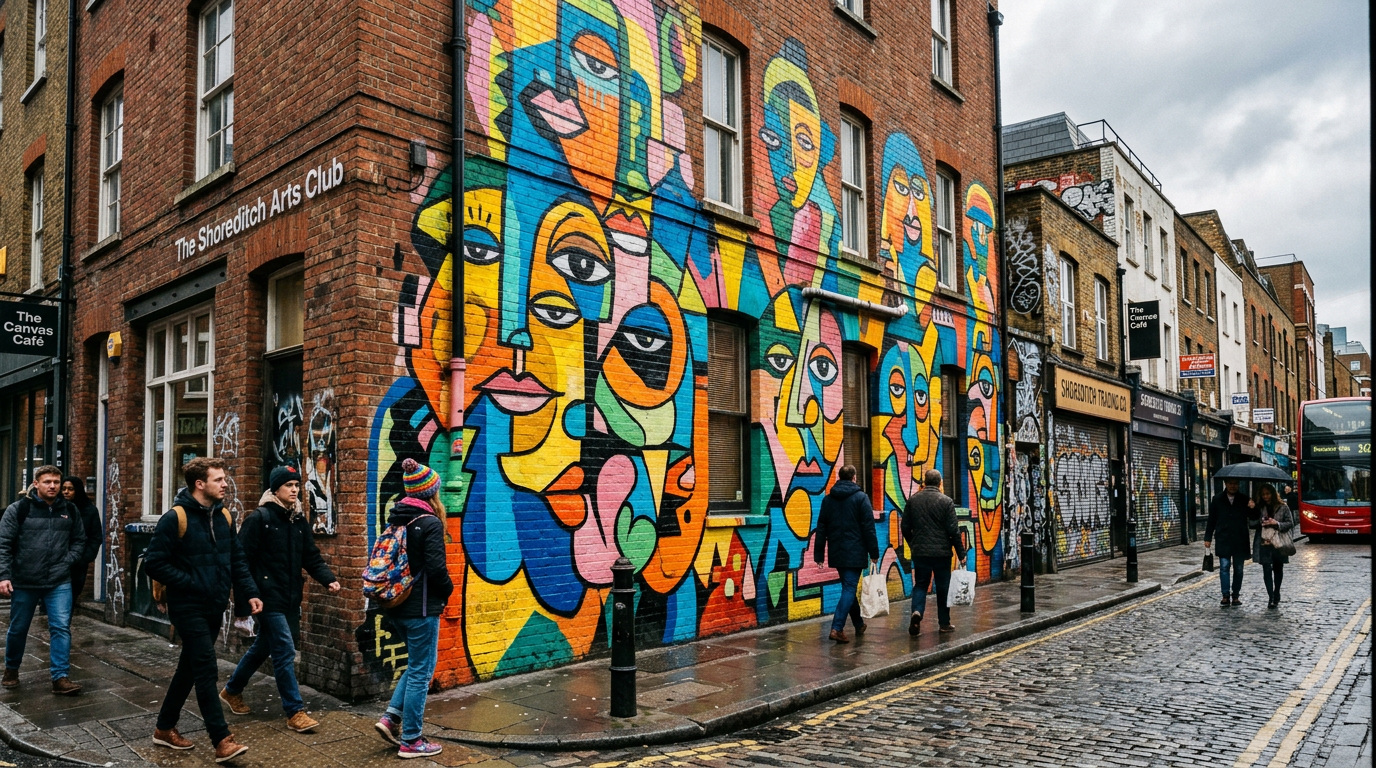
Stand on any street corner in Shoreditch, Bristol's Stokes Croft, or Manchester's Northern Quarter and you are surrounded by art that nobody commissioned, nobody paid for, and nobody asked permission to create. British street art has evolved from prosecutable vandalism into one of the most dynamic and globally influential art movements of the twenty-first century — a journey shaped by one anonymous figure from Bristol, and carried forward by a generation of artists who have taken the form in directions he never anticipated.
The Roots: Graffiti Culture Arrives in Britain
Street art in Britain did not begin with Banksy. Its roots reach back to the early 1980s, when New York's hip-hop culture crossed the Atlantic and London's first graffiti writers began tagging railway sidings and underpasses. Artists like Robbo, who was active in north London from 1985, and Mode 2, who brought a European graphic sensibility to London's walls, established a graffiti tradition years before stencil art became fashionable. Bristol developed its own parallel scene, influenced by the city's sound-system culture and the wild-style lettering of artists like Inkie, whose elaborate pieces on the walls of Barton Hill and St Pauls earned him both notoriety and, eventually, commercial success.
By the early 1990s, graffiti in Britain was firmly underground — illegal, stigmatised, and frequently painted over within hours. It would take a new approach, and a new artist, to bring it into the cultural mainstream.
Banksy and the Stencil Revolution
Banksy's emergence in the late 1990s changed everything. Working first in Bristol and then increasingly in London, he combined the speed of stencil technique with a satirical wit that made his work instantly legible to people who had never set foot in a gallery. Pieces like the Kissing Coppers in Brighton, the Girl with Balloon on Waterloo Bridge, and the Flower Thrower became global icons — reproduced on posters, T-shirts, and social media feeds billions of times over.
"Art should comfort the disturbed and disturb the comfortable." — Banksy
What set Banksy apart was not just the work itself but the way it was distributed. By keeping his identity secret and placing work in public spaces where anyone could encounter it, he turned the street into a gallery without walls or admission fees. The art world's response was conflicted — some dismissed him as a prankster, others recognised that he had fundamentally altered the relationship between art and its audience. His 2018 self-shredding of Girl with Balloon at Sotheby's, which only increased the work's value, captured that tension perfectly.
Stik: Simplicity as Strength
If Banksy made street art political, Stik made it personal. Working primarily in Hackney since the mid-2000s, Stik creates large-scale stick figures — simple, almost childlike forms that convey emotion through posture and gesture alone. His work is rooted in community: many of his pieces were created in collaboration with local residents, housing associations, and NHS trusts, and they address themes of homelessness, mental health, and belonging with a directness that more elaborate art often lacks.
Stik was himself homeless for a period, sleeping in doorways and hostels in east London, and that experience informs both the subject matter and the placement of his work. His figures appear on the sides of council estates, community centres, and hospital walls — locations chosen for their meaning, not their visibility. In 2020, his book Stik became a bestseller, but he continues to work primarily on the street, insisting that his art belongs in the places where people actually live.
D*Face: Pop Art Meets the Street
Dean Stockton, known as D*Face, brings a pop-art sensibility to British street art that owes as much to Roy Lichtenstein and Andy Warhol as it does to graffiti tradition. His signature imagery — skulls, winged hearts, crash-helmeted figures, and subverted comic-book heroines — is bold, graphic, and instantly recognisable. Based in London, D*Face has painted walls across the world, but some of his most striking work remains in the UK, including large-scale murals in Shoreditch and a series of interventions on commercial signage that blur the line between advertising and art.
D*Face is also significant as a gallery owner: his StolenSpace Gallery in Shoreditch has been one of London's primary venues for street art exhibitions since 2004, giving emerging artists a platform that bridges the gap between the street and the commercial art world.
Inkie: Bristol's Graffiti Pioneer
Tom Bingle, better known as Inkie, has been painting since 1983 and is widely considered one of the founding figures of British graffiti. His early work in Bristol — vivid, large-scale lettering influenced by New York wild style but adapted to British walls and British weather — helped establish the city as a creative hub years before Banksy emerged. Inkie was one of the artists arrested during the infamous 1989 Operation Anderson crackdown on Bristol's graffiti scene, an event that paradoxically raised the art form's profile and attracted a new generation of practitioners.
Now working across fine art, commercial design, and large-scale murals, Inkie represents the long arc of British street art — from criminal subculture to recognised cultural practice, without ever fully leaving the streets behind.
My Dog Sighs: Finding Beauty in the Discarded
Paul Stone, who works under the name My Dog Sighs, creates haunting painted portraits on crushed tin cans and other found objects, which he then leaves in the street for anyone to pick up. Based in Portsmouth, his work operates on the principle of the "Free Art Friday" movement — art as gift, not commodity. His larger murals, often featuring photorealistic closed eyes that seem to watch from the sides of buildings, have appeared across the UK and Europe. The combination of delicacy and urban grit in his work captures something essential about British street art: the insistence on finding beauty in unexpected places.
The Shoreditch Scene: London's Open-Air Gallery
No discussion of British street art is complete without Shoreditch. The streets around Brick Lane, Rivington Street, and the now-legendary Leake Street Tunnel (the "Banksy Tunnel" beneath Waterloo Station, where painting is legally permitted) constitute the densest concentration of street art in the country. Walls here turn over rapidly — a mural painted on Monday may be partially covered by Thursday — creating a constantly evolving exhibition that rewards repeat visits.
The area's significance is partly historical (many key British street artists, including Banksy, ROA, and Stik, have placed work here) and partly infrastructural: building owners in Shoreditch have largely embraced street art as an asset rather than a nuisance, and several walls are specifically allocated for rotating murals. The result is a neighbourhood where art is genuinely embedded in the streetscape, not confined to galleries or museums.
Bristol: Where It All Began
Bristol's claim as the spiritual home of British street art is difficult to dispute. The city's Stokes Croft neighbourhood functions as a permanent outdoor gallery, with major works by Banksy, Inkie, Nick Walker, and dozens of emerging artists covering almost every available surface. The Upfest festival, held annually in the Bedminster and Southville areas, is Europe's largest street art and graffiti festival, attracting over 400 artists and 40,000 visitors each year. Bristol City Council has adopted a broadly tolerant approach to street art (distinct from tagging, which is still prosecuted), and a 2015 poll found that 97% of Bristol residents considered street art a positive feature of the city.
The Legal Grey Area
The legal status of street art in Britain remains complicated. Under the Criminal Damage Act 1971 and the Anti-social Behaviour Act 2003, any mark made on property without the owner's consent is technically criminal damage, punishable by fine or imprisonment. In practice, enforcement varies enormously. Some councils — notably Bristol, Shoreditch (Tower Hamlets), and parts of Manchester — operate informal tolerance policies for street art of recognised quality, while others remove all unauthorised work regardless of artistic merit.
The situation is further complicated by the question of ownership. When a Banksy appears on a privately owned wall, who owns it? The building owner? The artist? The public? Several Banksy works have been removed and sold at auction for six- or seven-figure sums, prompting heated debate about whether street art, by its nature public and free, can legitimately become private property. No clear legal consensus has emerged, and the tension between art and property law remains one of the most interesting unresolved questions in contemporary British culture.
The New Wave: Where British Street Art Goes Next
The artists emerging in the 2020s are taking British street art in directions that would have been unrecognisable to the graffiti writers of the 1980s. Augmented reality layers are being integrated with physical murals, allowing viewers to use their phones to see animations and additional content overlaid on painted walls. Environmental themes dominate, with artists like Louis Masai creating large-scale murals of endangered species to draw attention to biodiversity loss. And the demographics of the scene are shifting: women artists, artists of colour, and artists from outside London are more visible than ever, challenging the historically white, male, London-centric narrative of British street art.
Community-led mural projects, often funded by local councils or arts organisations, are also reshaping the form. In cities from Glasgow to Margate, large-scale public murals are being used to regenerate neglected areas, celebrate local history, and give residents a sense of ownership over their built environment. Whether this represents the co-option of street art or its fulfilment depends on your perspective — but it is undeniably a sign that the form has moved from the margins to the mainstream.
Major UK Street Art Districts at a Glance
| Location | Key Artists | Legal Status | Guided Tours Available |
|---|---|---|---|
| Shoreditch, London | Banksy, ROA, Stik, D*Face, Ben Eine | Informally tolerated; some legal walls | Yes — multiple operators |
| Leake Street, London | Rotating; open to all | Legally permitted (designated space) | Yes |
| Stokes Croft, Bristol | Banksy, Inkie, Nick Walker, Voyder | Council-tolerated for quality work | Yes — Where The Wall, Bristol Street Art Tours |
| Bedminster, Bristol | Upfest artists (400+ annually) | Festival-sanctioned; largely legal | Yes — during Upfest |
| Northern Quarter, Manchester | Akse P19, Qubek, Hammo, Tankpetrol | Council-supported mural programme | Yes — Manchester Street Art Tours |
| Digbeth, Birmingham | High Vis festival artists, Gent 48 | Festival-tolerated; mixed enforcement | Limited |
| Ouseburn, Newcastle | Various local and international artists | Informally tolerated | Yes — occasional walking tours |
| Kelburn Castle, Ayrshire | Nina and Brazilian artists collective | Fully commissioned | Yes — castle grounds open to public |
| Glasgow, various | Smug, Rogue One, Art Pistol projects | Council mural programme | Yes — Glasgow Mural Trail |
| Brighton, various | REQ, Sinna One, Aida Wilde | Generally tolerated in key areas | Yes |
How to See British Street Art
The best way to experience street art is, of course, simply to walk. In London, a loop from Liverpool Street station through Shoreditch, down Brick Lane, and back via Bethnal Green Road will pass hundreds of works in under an hour. In Bristol, start at the top of Stokes Croft and walk south towards the harbour, detouring through the backstreets of St Pauls and Montpelier. Guided walking tours operate in most major cities and offer context that self-guided walks cannot — the stories behind specific pieces, the rivalries between artists, the walls that have been painted and repainted dozens of times.
- London: Shoreditch Street Art Tours, Alternative London, Street Art London
- Bristol: Where The Wall, Bristol Street Art Tours
- Manchester: Skyliner, Manchester Street Art Tours
- Glasgow: Glasgow Mural Trail (free, self-guided map available from the council)
Street art is, by definition, impermanent. The piece you see today may be gone tomorrow — painted over, weathered away, or replaced by something new. That impermanence is not a flaw but a feature: it makes every encounter with a great piece of street art feel urgent, personal, and unrepeatable. In a culture increasingly dominated by the permanent and the digital, there is something profoundly human about art that exists only in a specific place, at a specific time, for whoever happens to walk past.